

On the road to Turkana (and the road wasn’t as bad as Isanga  Bay, by the way) we crossed paths with a local woman and chatted for a bit. Laura operates the Salada Womens Camp outside of the town of Ngurunit; she said we’d like it for the beautiful scenery. We hadn’t a plan to go that way but why not? It is the beauty of not having a plan. Despite a mighty rain storm that washed out both the road to the camp and the piped water the camp is still open and we find it shady and comfortable after wild camping at Turkana. We are the only campers. And our luck in Kenya is still holding; we were lucky to meet Laura on the road because on the way to her camp, we witnessed an extraordinary sight, something we couldn’t have imagined.
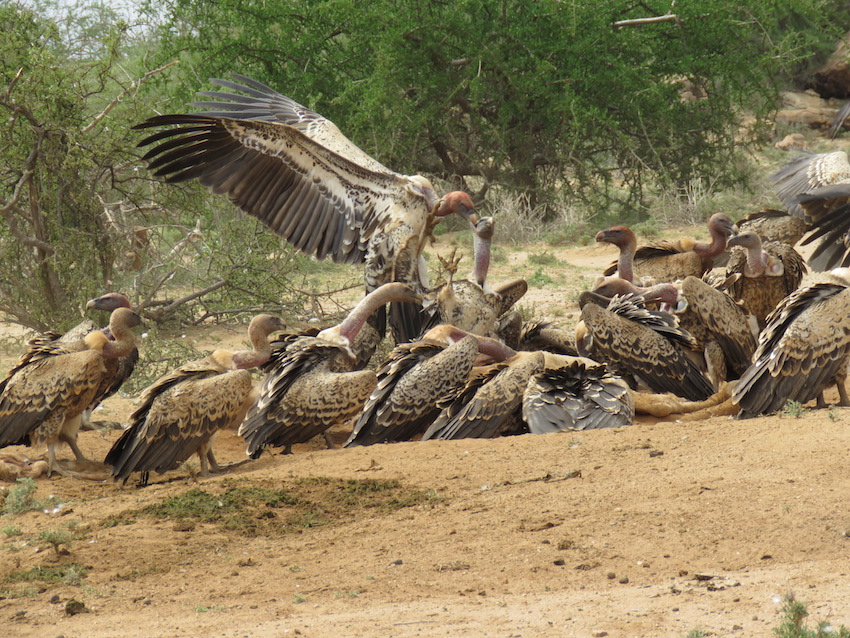
Rounding a corner on the rocky road, we spot several vultures  flying low to the ground. More are coming down and we coast up to the source of their interest, a camel carcass already blanketed with huge birds. The birds, Ruppell’s vultures, extend their naked necks and create an unholy racket fighting over the freshly dead beast. Loud growls, screeches, snapping beaks and vicious wing flaps drive away the smaller birds; the noise makes me think of a 19-century insane asylum. The biggest vultures come up from feeding with their necks red from blood and then they fight their way back into the center. Look at the cover photo of the vulture attacking the bird underneath it, grabbing neck skin with that brutal beak. Ouch!

It is a scene from an older time. We watch for an hour. A village dog comes racing in out of nowhere to scatter the birds and take off with a piece of meat. The birds quickly return to feed and fight. Various birds of prey arrive to get a taste. The small Hooded vulture hangs at the perimeter, picking up the scraps thrown out by the infighting. Finally we drive away and when we go by again three days later there is not a sign of the camel nor the birds. It’s like it never happened. Nature ca n be tidy like that.
In comparison, the elegant Vulturine Guineafowl sports a bare neck like a vulture but with stunning cobalt blue feathers front and back, lilac edging on the wing feathers and long trailing white neck feathers. It makes a racket but in a funny way, not the caveman’s nightmare of the Ruppell’s vultures. I’ve yet to find a blue feather from this lovely bird but I won’t stop trying.


Recent Comments